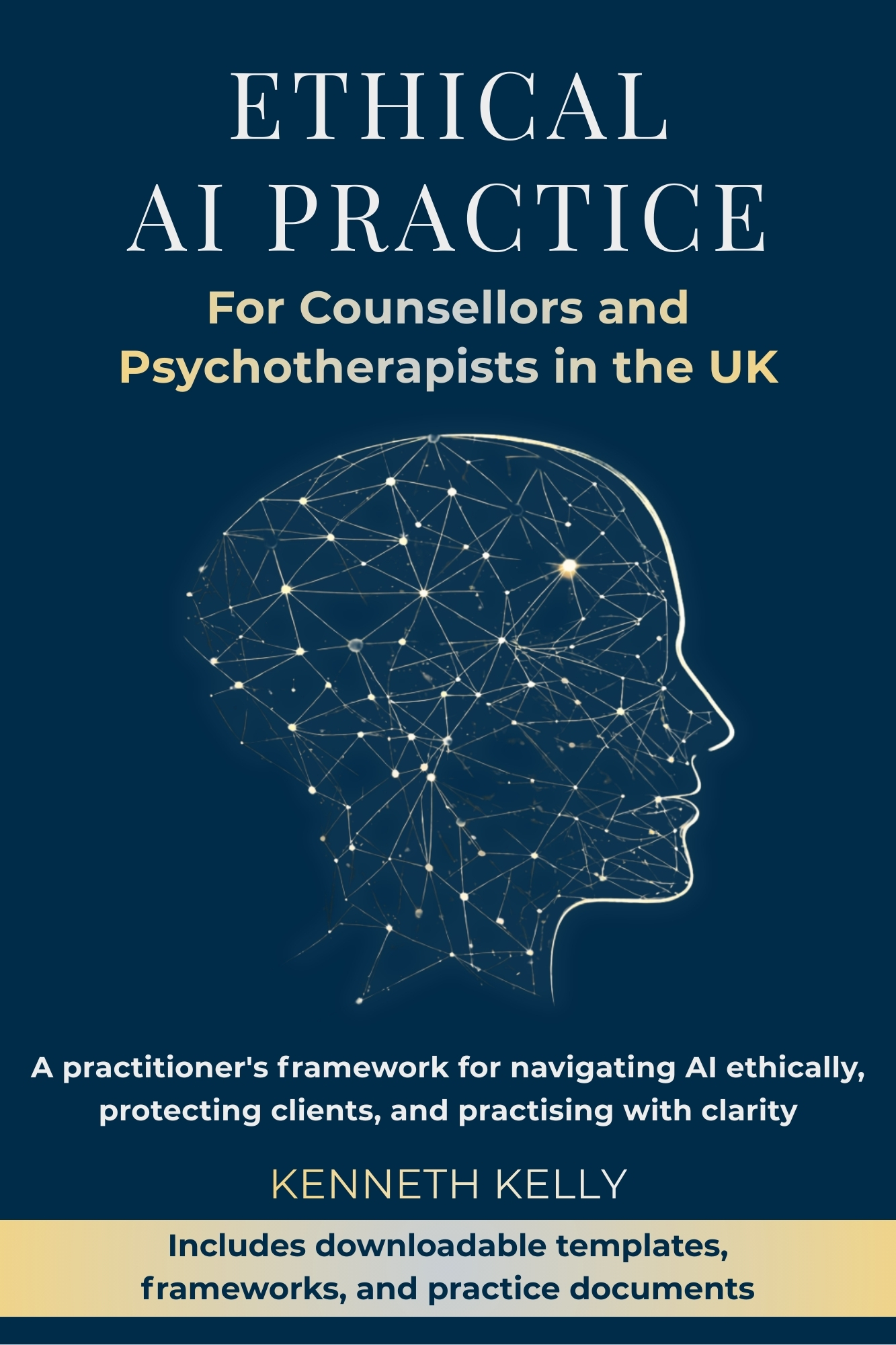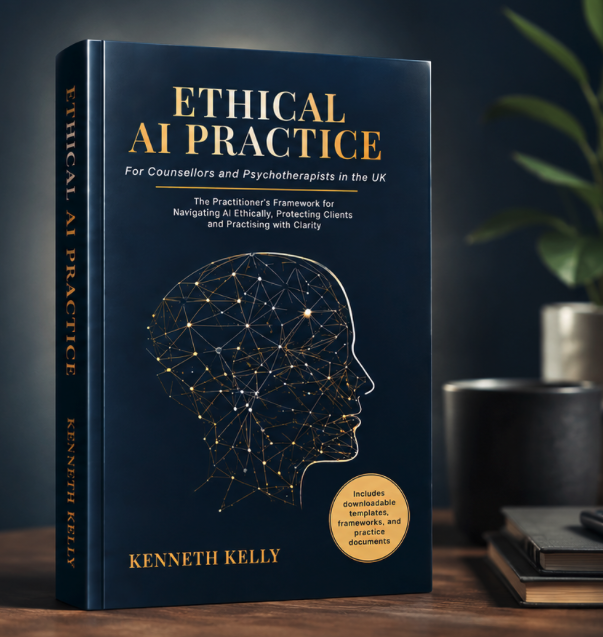

Everything you need to feature the book and interview Kenneth Kelly: bios, story angles, ready-to-ask questions, endorsements, and downloadable assets. Please get in touch for review copies and interviews.
A practitioner's framework for navigating AI ethically, protecting clients, and practising with clarity.
Also by Kenneth Kelly: Basic Counselling Skills: A Student Guide, and Online and Telephone Counselling: A Practitioner's Guide (with Rory Lees-Oakes).
Three lengths, ready to copy. Use the short version on air and the long version for features.
Kenneth Kelly is the AI Lead at Counselling Tutor and a founding member of the Expert Reference Group on Artificial Intelligence in Counselling and Psychotherapy (AIERG). He is a qualified counsellor, clinical supervisor and educator.
In 2023, Ken heard a representative from Google describe what AI would mean for every industry. His first question was about clients. How would this affect counsellors, psychotherapists, and the people sitting across from them in the therapy room? He returned to the UK and contacted the leaders of the professional bodies and training organisations. BACP, UKCP, NCPS, COSCA, CPCAB and others came to the table, and the AIERG was born.
Within that group, Ken saw that training practitioners on specific tools was a dead end, because the technology moves too quickly. That recognition led to the Critical Thinking Matrix at the heart of Ethical AI Practice. He is also the author of Basic Counselling Skills: A Student Guide and co-author, with Rory Lees-Oakes, of Online and Telephone Counselling: A Practitioner's Guide.
AI is already part of professional life, whether or not a practitioner chooses to use it. It is in the tools we rely on, and it is in the room with our clients. Every counsellor and psychotherapist is now ethically called upon to understand how to keep their practice and their clients safe.
Ethical AI Practice meets that need without requiring any technical background. It builds from the ethical reasoning practitioners already use and gives them a framework for applying it to AI. The book covers the Critical Thinking Matrix for evaluating any tool, what a therapeutic contract needs to say about AI, worked scenarios grounded in UK practice, and methods for defensible, auditable decision-making. It is grounded in the UK context: UK GDPR, MHRA and NICE guidance, the ICO, and the ethical frameworks of the professional bodies.
The book includes downloadable companion resources, including the Matrix as a fillable PDF, a contract clause, and an AI use policy guide.
Each angle is a conversation Ken can lead, with a reason it matters now. Choose the one that fits your audience.
The conversation about AI is already happening in therapy rooms across the country, and most practitioners have had no guidance on how to respond. Ken talks through what a counsellor can actually say and do, including what belongs in the therapeutic contract.
Professional bodies are developing their frameworks, and that careful work takes time. Practitioners need a way to make sound decisions today. Ken explains the thinking skills that hold up while the formal guidance is still being written.
The popular story is that AI takes jobs. Ken offers the view from inside the profession: as AI reshapes work and daily life, the human relationship at the centre of counselling becomes more important, not less.
In 2023 a single talk changed Ken's focus. He came home and brought the major bodies to one table. The origin story of the AIERG, and what it has been like to convene a profession around a fast-moving question.
Tools change month to month. Ken makes the case for critical thinking over tool training, and shows the structured questions that work on any tool, today or in ten years.
A grounded, plain-English explanation of confidentiality and data in the age of AI, including the everyday tools that quietly use it. Practical, not alarmist.
Ready to ask as they are. They are about the subject, so you can run a strong interview without having read the book.
Written answers, ready to quote or run.
In 2023 I sat in a conference and heard someone from Google describe what AI would mean for every industry. My mind went straight to the therapy room, to the people sitting across from us and to the practitioners trying to do right by them. I came home, contacted the professional bodies, and we formed a group to look at it together. The book grew out of that work.
Choosing not to use AI yourself is a legitimate professional position, and I respect it. The point is that your clients are still using it, and it is already inside the tools you rely on every day. Understanding it is part of keeping your clients safe. That responsibility does not depend on whether you personally adopt the technology.
No. If you can think critically about a client's presenting issue, you have everything you need. The book builds from the ethical reasoning you already do. It meets you where you are.
I think that is the wrong question for our profession. As more of life becomes automated, the human relationship at the heart of counselling becomes more valuable, not less. We are likely to be needed more. The task is to make sure we navigate the technology with our ethics intact.
That they already have what they need. They know how to think ethically. This book simply gives them a way to apply that thinking to AI, so they can practise with clarity instead of worry.
"The use of AI in relation to the counselling professions has increased exponentially over the last few years, bringing possible benefits, but also many ethical challenges. This is a very welcome book written in an accessible way that will enable all of us who are practitioners to reflect on our practice and ensure we continue to work ethically and safely with our clients."
"This is such a helpful and enlightening resource for counsellors and psychotherapists. Ken has really drawn out those questions in a way that's easy to understand, as well as being comprehensive, with good guidance to put everything into practice."
"As AI continues to impact the therapeutic landscape, therapists who engage with it critically will be best placed to navigate the nuances of this evolving technology. This book is a useful guide for practitioners on that journey."
"This very readable book speaks directly and convincingly to counsellors about why AI is important to them and their clients, and presents not only a map of AI but also a highly useful framework for asking the right ethical and reflective questions."
"A refreshingly supportive and helpful guide for UK-based counsellors and psychotherapists to navigate the evolving digital landscape without needing technical expertise. A gift in the form of a framework."
"Written for therapists of all stages of their career. Ken has written the book with an easy to understand framework and language that can be applied to any setting and needs to be on the desk of every practitioner who lives in a modern world of technology."
High-resolution files for print and web. Please credit the cover and photography to Counselling Tutor.