

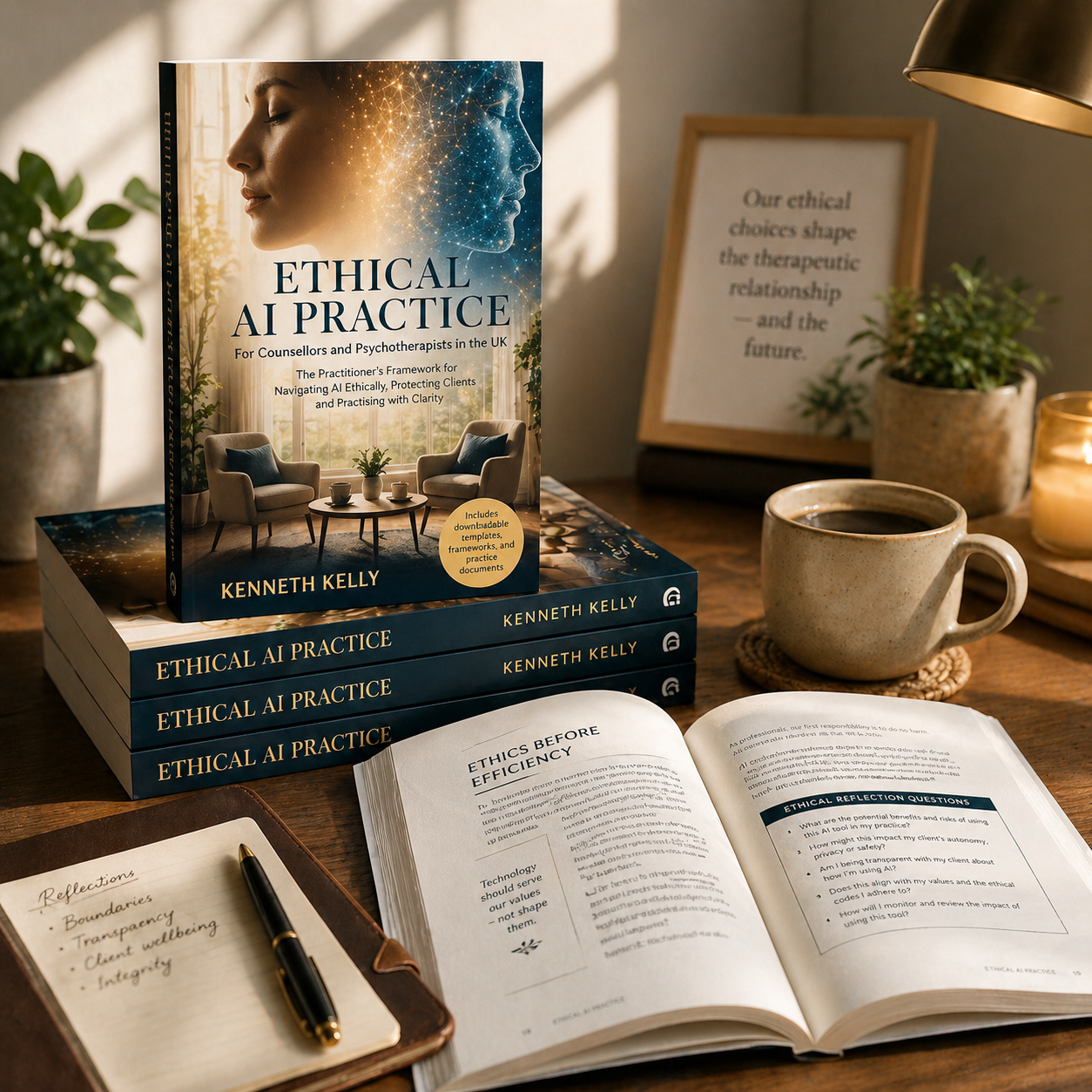
This book gives you a clear, grounded way to navigate AI as a counsellor or psychotherapist, built on the ethical thinking and professional judgement you already bring to your work every day. It is structured around:
Dr Susan Dale MBACP (Accred) Ethics Lead, British Association for Counselling and Psychotherapy (BACP)The use of AI in relation to the counselling professions has increased exponentially over the last few years, bringing possible benefits, but also many ethical challenges. This is a very welcome book written in an accessible way that will enable all of us who are practitioners to reflect on our practice and ensure we continue to work ethically and safely with our clients.
You may have decided you are never going to use AI personally, and that is a legitimate professional position. But the reality is, AI is already impacting your practice.
Your clients are using AI. They are turning to AI about their anxiety, using mood-tracking apps between sessions, checking your guidance against what an AI told them.
Every practitioner is ethically called upon to understand how to keep their practice and their clients safe in this technologically evolving world. Your professional body is asking you to respond. Your clients deserve a practitioner who can protect them, whether that means understanding the AI tools they are using or knowing what is happening to their data.
This book helps you navigate all of this and much more.
"A very welcome book, written in an accessible way that will enable all of us as practitioners to reflect on our practice and continue to work ethically and safely with our clients."
"This is such a helpful and enlightening resource for counsellors and psychotherapists. Ken has really drawn out those questions in a way that's easy to understand, as well as being comprehensive, with good guidance to put everything into practice."
"This very readable book speaks directly and convincingly to counsellors about why AI is important to them and their clients, and presents not only a map of AI but also a highly useful framework for asking the right ethical and reflective questions."
"As AI continues to impact the therapeutic landscape, therapists who engage with it critically will be best placed to navigate the nuances of this evolving technology. This book is a useful guide for practitioners on that journey."
"A refreshingly supportive and helpful guide for UK-based counsellors and psychotherapists to navigate the evolving digital landscape without needing technical expertise. A gift in the form of a framework, Critical Thinking Matrix, that allows practitioners to evaluate any digital tool against established sector professional and ethical standards."
"Written for therapists of all stages of their career. Ken has written the book with an easy to understand framework and language that can be applied to any setting and needs to be on the desk of every practitioner who lives in a modern world of technology."
A structured method for ethically evaluating any AI tool you encounter, whether it exists today or arrives five years from now. Ten domains. Thirty-five reflective questions. Bring it to supervision or share it with your organisation.
What your therapeutic contract needs to include around AI, and how this protects your practice and your clients. A practical contract clause you can adapt for your modality and your way of working.
Real-life scenarios grounded in UK counselling and psychotherapy practice: evaluating a commercial practice tool, understanding why client data must never enter a large language model, navigating invisible AI, and responding when a client discloses they are using a mental health app.
Auditable processes for defensible decision-making and professional credibility. Documentation templates and a supervision integration model. When a professional body asks how you reached a decision, you can show the reasoning.
Practical methods for building practice documents, staying current with developments in your field, and ensuring your practice is ready for what is ahead. Build your professional voice profile, create your AI use policy step by step, and develop a sustainable practice for staying current as the landscape moves.
Your clients are already using AI. They are asking ChatGPT for mental health advice, using mood-tracking apps, or checking your guidance against what an AI told them. You need to know how to respond professionally.
You are guiding practitioners through new ethical territory. The questions coming into supervision are changing, and you want a framework to support the practitioners you work with.
You know AI is part of your professional landscape. You want to start your career with a clear, grounded understanding of how to navigate this ethically.
You are a social worker, nurse, teacher, or other helping professional. The ethical questions around AI and the people you support apply to you too.

Kenneth Kelly is the AI Lead at Counselling Tutor and a founding member of the Expert Reference Group on Artificial Intelligence in Counselling and Psychotherapy (AIERG). He is a qualified counsellor, clinical supervisor, and educator.
In 2023, Ken attended a conference where he heard a representative from Google speak about what AI would mean for every industry. His immediate question was about clients. How would this technology affect counsellors, psychotherapists, and the people sitting across from them in the therapy room?
He returned to the UK and contacted the leaders of the professional bodies and training organisations that represent the profession. BACP, UKCP, NCPS, COSCA, CPCAB, and others came to the table. From that, the AIERG was born: a cross-sector group committed to examining best practice and sharing knowledge with practitioners.
That approach became the Critical Thinking Matrix: a set of structured questions practitioners can apply to any AI tool, now or ten years from now.
Ken is also the author of Basic Counselling Skills: A Student Guide, which has sold thousands of copies worldwide and is recommended reading in training centres across the UK. Through Counselling Tutor, he has taught and supported thousands of counsellors across the UK and internationally.
Includes downloadable companion resources: frameworks, templates, and practice documents.
No. I have written it for practitioners, not technologists. If you can think critically about a client's presenting issue, you have everything you need to engage with this material. The book meets you where you are and builds from what you already know.
Yes. The frameworks are modality-independent. Whether you are person-centred, integrative, CBT, psychodynamic, or any other approach, the ethical questions around AI apply equally. The book is grounded in the shared professional and ethical foundations that sit beneath all modalities.
The book is written for practitioners at all career stages. Qualified practitioners and supervisors may find it particularly relevant, because they are the ones fielding the questions and making the decisions right now.
Yes. The book is grounded in UK GDPR, MHRA guidance, NICE standards, and the ethical frameworks of BACP, UKCP, NCPS, and COSCA. It also references the Data Use and Access Act and the UK government's approach to AI regulation. This is written specifically for the UK professional context.
The book includes downloadable companion resources: the Critical Thinking Matrix as a standalone fillable PDF, a therapeutic contract clause you can adapt for your practice, an AI use policy building guide, worked examples from the book laid out as complete conversations, and selected AI prompts. You can access them through a link on the first page of the book.
Yes. The book is available as both a softback and an ebook on Amazon.